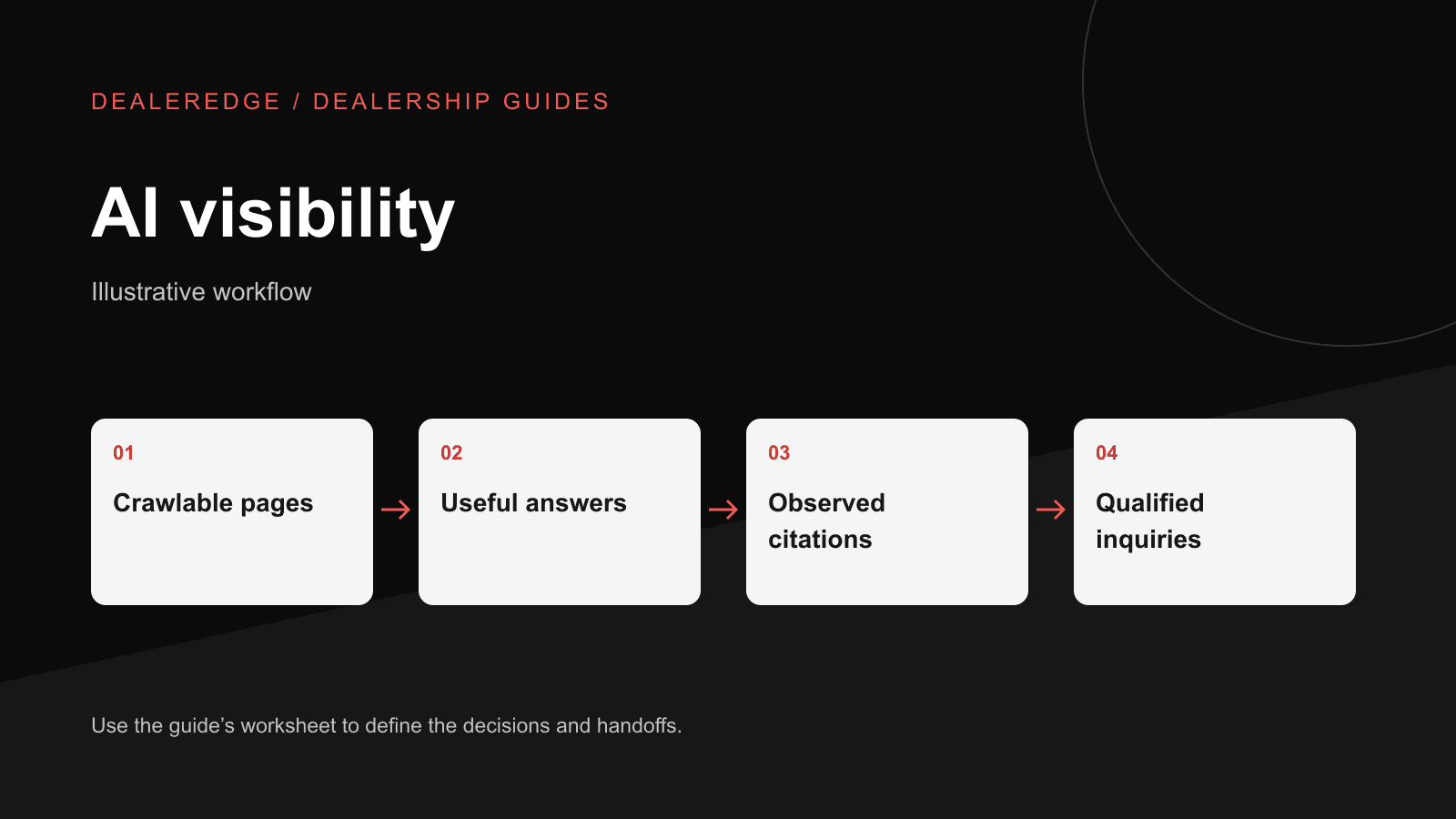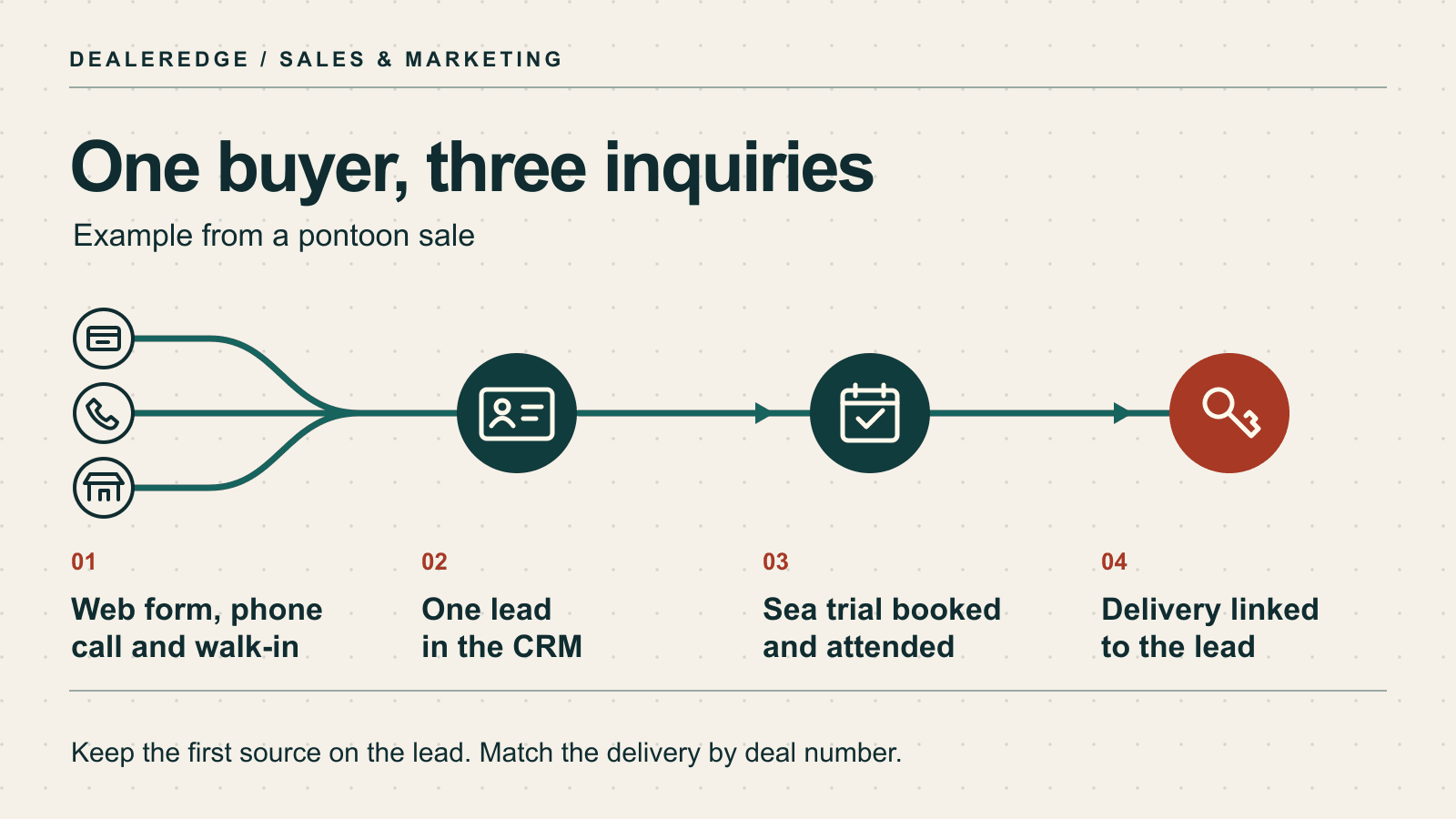
AI can draft listing descriptions and ad variations for a whole group of boats, but it writes from whatever record you give it. A wrong engine spec or the wrong photos then end up in every version. Before a group goes into a campaign, its records, photos and landing page should answer the buyer's question, and the store should be ready to handle the inquiries the campaign produces.
Pick the priority group, the buyer's question and the timing
Choose one group of units and write down why it matters to the business. Then write the question a buyer of those units is most likely to ask. That question decides which specs, photos and next step the listing needs.
Business priority | Example group | The buyer's question |
|---|---|---|
Aged used inventory | Used pontoons on the lot for more than 90 days | "Is something wrong with it, and what is it really worth?" |
Prior-model-year new units | Last year's bowriders before the new models arrive | "What's different from this year's model, and is the discount worth it?" |
Boat show units | The models going to the show | "Can I see it, and what will it cost rigged the way I want?" |
Fresh trade-ins | Clean trades taken in this month | "What condition is it in, and does it come with a trailer?" |
Examples. Use the groups your store actually needs to move.
Timing matters as much as selection. DealerEdge's boat search seasonality benchmark finds that national boat searches climb from a December low to a July peak, with about half the year's searches falling between May and August. From July to October, they fall about 61%. A group of summer boats prepared in late winter is ready before that peak; the same group promoted in October meets far less search activity. Seasons vary by state and product, so check your own market before you set dates.
Confirm each unit's specs, status and price
Every listing, ad and description should draw on one confirmed record for the unit. Boat Inventory Syndication explains how to keep that record consistent across channels. For a campaign, confirm these fields first:
Field | Why the buyer cares |
|---|---|
Year, make, model and length | The basic match to what they searched for |
Engine make, model, horsepower and hours | Hours drive a used boat's value and condition questions |
Trailer included or not | Changes the real price |
Status: available, pending or sold | A sold unit in an ad wastes the click and the buyer's patience |
Price and what it includes | Fees, prep and freight change the comparison |
Location | Which store has it, and whether it can be moved |
Equipment confirmed on this unit | A buyer is paying for what is installed, not the model's option list |
Condition notes and service history, for used units | The answer to "is something wrong with it?" |
Give the AI only the confirmed record, including manufacturer specifications you've matched to this exact model and year. If a field is blank, the copy should leave it out or invite the buyer to ask. Never assume an option is installed because the model offers it.
From that record, AI is useful for drafting descriptions, writing ad variations for different placements, writing image alt text and finding the right photos in a well-tagged library. Confirming equipment and condition, setting the price and filling any gap in the record stay with someone who knows the unit.
Choose photos that answer the buyer's question
Pick photos for the buyer's question, not only for looks.
Aged used pontoon: the engine-hours display, upholstery close-ups, the deck and fencing, and the pontoon tubes.
Prior-model-year bowrider: the features that differ from the new model, so the buyer can judge the discount.
Fresh trade-in: the hull, the engine, the trailer and any wear the description mentions.
Use photos of the actual unit for anything used. Manufacturer images show a boat the buyer isn't getting.
Don't edit a photo in a way that changes the boat. Adding equipment, removing scuffs or repairing damage in an image misrepresents the unit, and the buyer will see the difference at the dock. Also check for text burned into older photos, such as a past sale banner or last season's price.
Send the click to a page that answers the same question
An ad about one unit should land on that unit's page. An ad about a group, such as used pontoons under 24 feet, should land on a list filtered to exactly that group. If the page shows something different from the ad, the buyer has to start the search again.
A new landing page earns its place only when the buyer's task differs from what an existing page offers, and you have enough inventory to fulfill it. Otherwise, a well-filtered inventory page does the job.
Give each page one clear next step that fits the question: check availability, book a sea trial or value a trade.
Check tracking and staffing before launch
Tracking: tag the campaign's links and test that an inquiry arrives with its source.
Ownership: every inquiry needs an owner and a backup, including those that arrive at night. After-Hours Lead Response covers the routing table.
Capacity: if the campaign runs into a boat show weekend, make sure the team can answer the inquiries it produces.
Sold units: remove a unit from the campaign as soon as it sells.
Judge the campaign on qualified inquiries and attended appointments
Impressions show exposure and clicks show interaction. Neither tells you whether the units were ready to sell. Review the group each week. Dealership Marketing Attribution defines a qualified lead and the fields you need to match inquiries to appointments and sales.
Unit or group | Qualified inquiries | Appointments booked | Appointments attended | Sold | Notes |
|---|---|---|---|---|---|
If a unit draws inquiries but no visits, read those conversations before changing anything. The cause might be a missing fact, the price, slow follow-up or visit times that didn't suit the buyer. Fix what the conversations show.
Checklist: is this unit ready to promote?
Run this before a unit or group goes into a campaign.
Check | Done |
|---|---|
Business priority and buyer question written down | |
Status, price and location confirmed today | |
Specs confirmed against the unit, not the model's option list | |
Engine hours recorded and shown, for used units | |
Photos are of this unit and answer the buyer's question | |
No photo edits that change the boat; no old promotional text in images | |
Description drafted only from confirmed fields and read by someone who has seen the unit | |
Destination page shows the same unit or group as the ad | |
One clear next step on the page | |
Campaign links tagged and a test inquiry received with its source | |
Owner and backup assigned for inquiries | |
A plan to remove the unit from the campaign when it sells |
Example: one listing, before and after
Hypothetical example. The boat, store, price and details are invented.
Before
2019 22' Pontoon, LOADED! Great condition, must see! Tons of extras. Call today for the best price!
Photos: three manufacturer brochure images.
After
2019 Harbor & Pine 22 Tri-Toon, Yamaha F150 outboard, 212 hours, trailer included
Available at our Lakeside store (status confirmed November 17). $38,900 plus a $399 documentation fee; prep included.
Equipment on this boat: bimini top, stereo with two speakers, swim ladder and depth finder.
Condition: upholstery is in good shape, with light wear on the helm seat (photo 7). Service records since 2021.
Photos: 18 of this boat, including the engine-hours display, helm, seating layout, tubes and trailer.
Book a lake test →
Nothing about the boat changed. The second version answers the condition questions a used-pontoon buyer asks (hours, equipment, wear and service history) and states the full price, so the buyer can weigh its value against other boats they're considering. It also gives one next step. Whether it draws more inquiries is what the weekly review will show.
Prepare a priority group with DealerEdge
DealerEdge chooses images from your own media library and matches them to the right brand and model; for a used unit, keep photos of that boat in the library. Its text detection keeps an old promotional banner out of a hero image, and a clean-photo filter hides images with burned-in text or a price badge. Campaign landing pages it builds carry campaign tracking into the form, though you should still send a test inquiry to confirm its source arrives. Ads wait until their landing page is published. Read more about DealerEdge marketing and how it handles inventory.
To see it with your own boats, bring one priority group and its current listings to a DealerEdge demo. Get an email when the next demo is scheduled, or request a private walkthrough to work through your own inventory.